What Is Tuckpointing, and How Is It Different From Repointing?
Tuckpointing is strictly a decorative finish that uses two mortar colors to make joints look very fine. Repointing is cutting out failed mortar and packing in new, and Twin Cities masons use both words for that repair.
Our tuckpointing and repointing service uses the word in that everyday sense. What counts on your wall is what happens to the joints. Read the written scope, whatever word it uses.
What is tuckpointing?
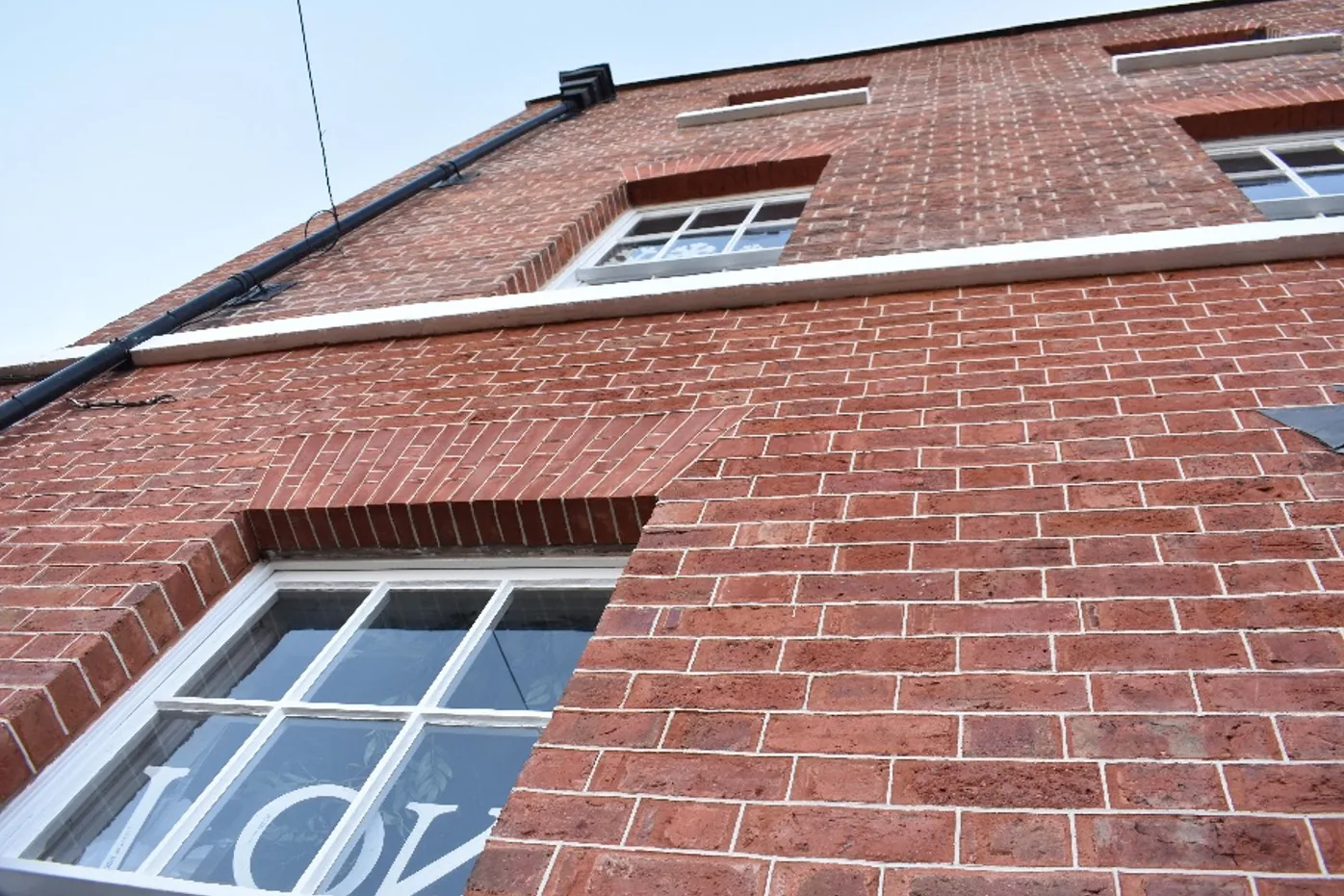
In the strict sense, tuckpointing is a joint finish done with two mortar colors. Mortar colored to match the brick fills the joints level with the brick face. A narrow groove is scored along each joint. A thin ribbon of contrasting mortar, usually white, is then pressed, or tucked, into that groove.
The result looks like very fine, regular joints. Masons in England were using it by the late 1700s. It let cheap brick copy the look of rubbed brick. Rubbed brick was cut to a precise size and laid with very fine white joints.
The National Park Service calls tuckpointing primarily decorative. Its Preservation Brief 2 describes a raised mortar joint or lime putty joint on top of flush mortar joints. That makes strict tuckpointing a finish, and the repair is a separate job.
What is repointing?
Repointing is removing deteriorated mortar from the joints of a masonry wall and replacing it with new mortar. That is the National Park Service definition. Done badly, repointing hurts the look of the building and may damage the brick itself.
Two rules in Preservation Brief 2 matter most. The first is depth. Old mortar comes out to a minimum depth of 2 to 2.5 times the joint width. The new mortar needs that depth to bond well and stay in the joint.
The second rule is softness. New mortar must be softer than the brick. Water vapor must also pass through it more easily. Stress in a wall should be taken up by the mortar rather than the brick.
The new mortar goes in by layers. Each layer is about 1/4 inch thick and packed well into the back of the joint. The next layer goes on once the last one reaches thumb-print hardness.
A related word is pointing. It means finishing the joints on newly laid masonry, and repointing means redoing them on old masonry.
Why do people use both words for the same job?
The word took on a wider meaning outside the UK. SPAB is the Society for the Protection of Ancient Buildings, a British conservation charity. It says that outside the UK, the term has sometimes covered all forms of repointing. In parts of the United States and Canada, tuckpointing, pointing and repointing are often used for the same work.
The National Park Service lists tuck pointing as another name for repointing, then gives the word its narrower meaning. The everyday use is normal in the Twin Cities. A 2015 draft from the Saint Paul Heritage Preservation Commission writes “repointing (tuckpointing)” for one maintenance job. An older City of Saint Paul permit handout lists tuckpointing with siding and roof patching as exterior repairs.
Our chimney tuckpointing page uses the word the same way for joint repair on a chimney. Here, a bid that says tuckpointing usually means that repair.
How do tuckpointing and repointing compare?
Strict tuckpointing changes how a joint looks, and repointing renews the joint. A skim of new mortar over the old joints only covers them. It gets its own column here because a cheap bid can use one under either word.
Strict tuckpointing, repointing and a skim compared. Sources: National Park Service Preservation Brief 2, the Society for the Protection of Ancient Buildings and The Construction Specifier.
| What to compare | Strict tuckpointing | Repointing | Skim over the joints |
|---|---|---|---|
| What happens to the old mortar | Raked out if old tuckpointing is being renewed, then filled level for the ribbon | Cut out to at least 2 to 2.5 times the joint width, then packed with new mortar | Stays in place under a thin layer of new mortar |
| Purpose | Decoration, so the joints look finer and more regular | Repair, to restore the wall and keep water out | Covers worn joints from view |
| What it looks like | A thin ribbon, usually white, on mortar that matches the brick | New joints that match the old mortar and the old finish | A thin layer that can spread past the joint and make it look wider |
| How long it lasts | We found no published figure. The ribbon can fade while the joints stay sound | Meant to last at least 30 years, and preferably 50 to 100 years | On one 1920s building, a thin layer cracked and came loose within a few years |
A skim is the one to watch for on a bid. Britain’s Local Authority Building Control says a thin layer will not fully stick to the joint. It also says the layer lacks the depth to stand up to weather.
The 1920s case in the table comes from The Construction Specifier. The failed layer let water into that office building. The National Park Service adds that shortcuts and poor craftsmanship mean repointing again sooner.
Which one does an older Minneapolis brick wall need?
An older Minneapolis brick wall needs repointing once its joints have failed. Minnesota walls go through 80 to 100 freeze and thaw cycles a year.
About 4 in 10 Minneapolis housing units went up in 1939 or earlier. The Census Bureau’s 2024 American Community Survey counts 87,975 of 216,155. That count covers all housing, brick or not.
The Saint Paul draft gives a plain test. Repointing fits joints where mortar is missing to a depth at least equal to the joint width. It also fits joints where the mortar has come fully away from the masonry. That draft covers limestone buildings, and SPAB gives the same depth test for pointing in general.
A strict ribbon joint only matters on a wall that was built with it. The Park Service brief mentions it on a house from about the 1920s, so older walls can have it. SPAB says it can go unnoticed once it has weathered. Traces may survive in sheltered spots, such as under window sills or eaves.
If you find thin raised lines in those spots, put that in the scope before any joint gets cut. SPAB says tuck pointing is very difficult to renew in small areas that blend in. It also says a faint ribbon alone does not justify redoing sound joints.
What should a written scope say?
Whatever word the contractor uses, the scope should name the depth, mortar, sample area, tools and joints covered. If a bid says tuckpointing and gives no depth, ask for one before you sign.
- Depth. Old mortar comes out to at least 2 to 2.5 times the joint width. For most brick joints, the Park Service says that is about 1/2 inch to 1 inch.
- Mortar. The mix should be softer than the brick and no harder than the old mortar. It should also match the old mortar in color.
- Sample area. The Park Service calls this a test panel. About 3 feet by 3 feet is usually enough on brick. It should sit away from the front of the building. It sets the standard for the rest of the wall.
- Tools. The Park Service warns that unskilled use of power tools can be disastrous for historic masonry. Ask how the joints will be cut out.
- Joints covered. The Saint Paul draft says repointing should only be done on areas that need repair. The scope should name the walls or joints that get the work.
Those lines are what the price covers. Published price ranges are in our tuckpointing cost guide and our chimney tuckpointing cost guide.
When does a wall need more than joint work?
A wall needs more than joint work when the brick itself has failed. Spalled or loose brick goes to brick repair. A chimney with a loose stack goes to chimney rebuilds.
The source of the water has to be fixed too. The Park Service names leaking roofs and gutters among the root causes to deal with before repointing. Without that repair, it says, the mortar will keep breaking down.
We look at the wall on a site visit and price the scope in writing. The scope says what happens to the joints, whichever word you use when you call.